
A short guide
The Weaves
Three traditions sit in our wardrobe today. Here is how each is made, and what to look for when you choose one.

Banarasi Silk
Silk sarees in the tradition of Varanasi, where the pattern is woven into the cloth on a jacquard loom rather than printed on it. Buttis, borders and pallus are built thread by thread, so the motif shows its floats on the reverse.
- Dual-Tone JacquardTwo colours in one saree: the body in one, the border and pallu in another, the edge between them softened by the weave. A younger way to wear a classic.
- Jacquard ButtiSmall round motifs woven at even intervals across the body, with a broad zari-toned border and a striped pallu. The most versatile Banarasi — as right at a puja as at an evening function.
Batik
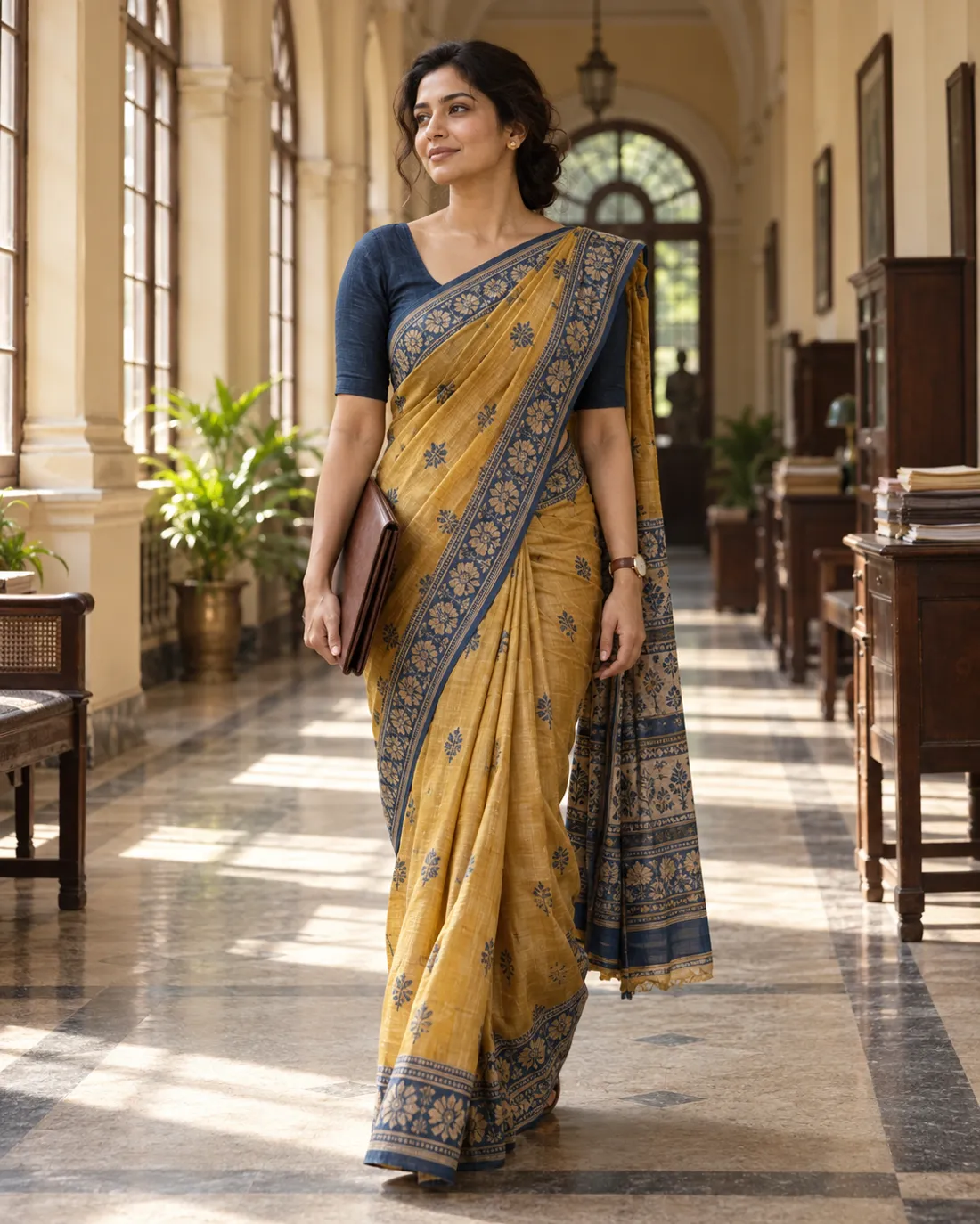
Wax-resist dyeing: the pattern is drawn in hot wax, the cloth is dyed, the wax is washed away. The fine crackle lines where the dye seeps in are the signature of the hand.
- Batik Suit SetsUnstitched three-piece sets: batik-print top, plain bottom and a discharge-print dupatta, 2.5 m each.
- Hand Batik SareesHand batik sarees with a silver border and a blouse piece. Light and easy for everyday and office wear.

Katan Silk
Katan is silk woven from twisted yarn, which gives the fabric body, a soft sheen and a fall that holds its pleats. It takes embroidery and printing beautifully.
- Discharge PrintThe silk is dyed first, then the colour is lifted out to leave the motif behind. The print stays soft, with no stiff layer of ink on top.
- Screen PrintBold block-print vocabulary — dense florals, motif borders, buttas in the pallu — screen and discharge printed onto Katan silk.
- Thread EmbroideryKatan silk worked with fine thread embroidery — trailing leaves, heart buttis or a full floral jaal — finished with a striped pallu and tassels. Fast colours, with a 1 m blouse piece.
Tissue Linen
Linen woven with tissue: a fine metallic weft runs through the cloth, so the whole saree carries a soft gold sheen while staying light and airy to wear.
See all Tissue Linen